

After leaving Singapore, what I miss the most is the CareCorner counseling center. I volunteered there for three hours a week, helping people in need of mental support, among all the age groups. It allowed me to see the world from completely different perspectives, and be grateful for what I have everyday. My co-volunteers had been there for many years, even decades. I had supervisors in their 70’s and 80’s, who would mentor me and help me discover the deeply unmet needs of those individuals, and find a way to explore it with the person. We helped them find their own strength to champion their own life. It was a truly memorable experience .
Looking For Volunteer Opportunities
After my family moved to the United States six months ago, one of the first things we did after settling down was to search for similar volunteer opportunities. One day, my husband told me about a volunteer organization called Good Grief. He mentioned that a neighbor who had lost her husband 5 years ago shared it in a community group, and he thought I might be interested.
When I opened Good Grief’s website at https://good-grief.org/, I was deeply moved by the first video. Seeing so many children who had experienced the pain of losing a loved one, I couldn’t help but wonder how their lives would continue. It’s hard for me to imagine.
Further exploring the website, I discovered that Good Grief has open house events, offering tours once or twice a month. Without hesitation, I immediately wrote an email to the center manager, inquiring if it would be possible to visit within the upcoming week. I received a positive response shortly. Excitedly I went there on a Monday noon.
Attending Tour
Good Grief has two centers in New Jersey, one in Morristown and another in Princeton. Since Morristown is closer to my home, we chose that one. On the day of the tour, there were about eight people sitting around in a circle. The center manager, a kind and calm lady, patiently introduced us about the organization.
Good Grief is a community organization established in 2004. At that time, a group of volunteers realized that, children who experienced the loss of parent(s) lacked systematic support. As a result, these volunteers started to provide support for these families, helping them navigate through their most challenging days. Over the years, Good Grief has grown significantly. In 2022 alone, it has served over 1,000 children and adults. It is worth mentioning that Good Grief does not receive any government funding. It relies entirely on volunteers and donations from the community to sustain its operations.
There are two types of volunteers at Good Grief:
- Facilitators: Families with loss could join Good Grief’s Night of Support activities at the center every other week, led by facilitators. The goal of these activities is to leverage peer support, and help them find internal and external resources to better cope with their emotions and situations. In this safe environment, individuals in similar situations can share their experiences, support one another, and learn from each other. Depending on their age, children and parents are assigned to different groups: Green Group (ages 3-5), Orange Group (ages 6-9), Blue Group (ages 10-12), Purple Group (ages 13-18). Additionally, there are separate spouse loss & child loss adult groups. Each group is supported by 2-4 facilitators who lead activities such as exploring their needs and emotions, and guiding children to express their emotions through games and art activities too.
- Greeters: The activities generally take place from 7:00 to 8:15 in the evening. Many families come directly from work, without even having time for dinner. Good Grief greeters prepare pizza and water for everyone, ensuring that these families can at least save the time to prepare a meal while they are at Good Grief. Greeters would also clean the dining area afterwards.
Good Grief Functional Rooms
After the introduction, the center manager took us on a tour of the Good Grief office building. It was a three-story residential house, with each room serving a specific functional purpose.

- Picture Wall: Families participating in Good Grief can place photos of their departed loved ones on this wall. The wall is covered with layers of beautiful pictures, constantly reminding people of the cherished memories and the infinite love for their family members.
- Message Wall: People can write messages to their departed loved ones on colorful sticky notes and place them on this dedicated message wall. (Image 1)
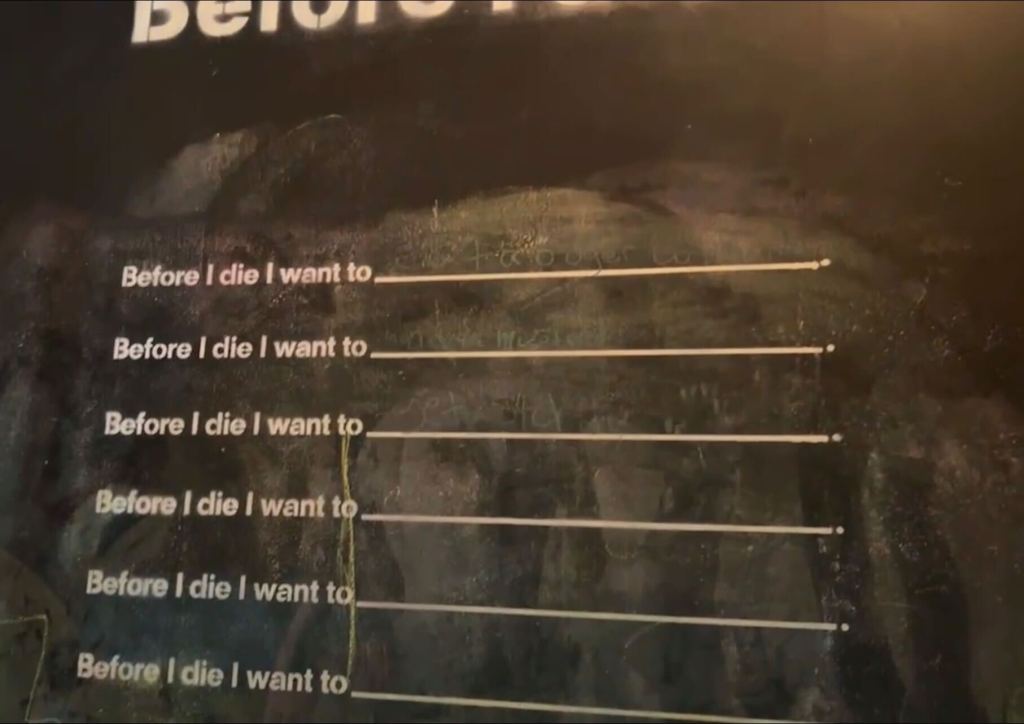
- Wish Wall: Individuals can write down their own wishes and aspirations. (Image 2)
- Music Room: A room with various musical instruments and costumes. Many children can use music to express their feelings.
- Hospital Room: With a hospital bed, dolls, and mini medical instruments. Many children may have seen their families in the hospital for a long time before they pass away. The hospital room holds a special space for those children. They can each pretend to be doctors and patients in this hospital room.
- Volcano Room: A room surrounded by soft covers, with equipment such as punching bags, yoga balls. This safe space allows children to release various emotions, including anger.
- Sand Room: It features a sand table where children can express their emotions through playing with sand.

Other than these specific functional rooms, each age group would mostly stay in a designated room suitable for their age, to carry out their activities every evening. Sometimes, the children take turns using the aforementioned functional rooms. This short video can give you a general understanding of the nightly process.
After the visit, I immediately decided that this was the place I had been looking for and signed up to become a facilitator. Additionally, becoming a facilitator required at least 36 hours (4 full days) of training. Luckily, the next training session was scheduled one week later. I quickly requested time off from work and managed to attend the training that took place a week later.
Attending Training
Before attending the training, Good Grief conducted a background check on me to ensure that I had no criminal records or mental health issues. This requirement was necessary, especially since we need to work with children. Additionally, I needed to obtain three referrals. As I was scheduled to attend the training in a week, I quickly asked my boss, and two other family members to help me write a recommendation letter.
The entire training experience was extremely impactful, even though I had participated in numerous counseling-related trainings before, this training was still super powerful.
Day 1: Each person had to share their grief journey. It was emphasized that if we couldn’t process our own grief, it would be difficult for us to accept and guide others on their grief journey. Among the 30 trainees, each had an extraordinary story to tell. Personally I thought I had mourned and processed the sadness of my grandmother’s passing a few months ago through writing a book for her, but during the sharing session, I found myself choked with tears. It made me realize that in the process of grieving, I needed to better reconcile my relationship with my grandmother, even though she was no longer here. The experiences shared by others further reminded me of life’s impermanence. I admired the resilience this group of people showed up. There was one particular person whose story touched me deeply, and I plan to write about her in the future.
Day 2: Explaining the roles and meaning of being a facilitator. Facilitators help others find meaning in their lives again and discover new goals and hope. The role of a facilitator was not to provide advice or solutions but to ask questions that would enable individuals to find their own answers. The senior counsellor who conducted the training shared an excellent metaphor: “Just be the crust.” The most important part of a pie is its filling, and the families who come to Good Grief are the filling. Facilitators are merely the crust, bringing everyone together to collectively find resources and hope.
Days 3-4: Introducing techniques for facilitating with practice. We learned how to manage silence, establish necessary rules (such as confidentiality agreements), and make use of tools for interacting with children (e.g., sensory dice). Through simulations, we familiarized ourselves with the program.
There were nearly 10 interns in this training, many of whom were psychology or sociology students. Good Grief was highly recommended as an internship site, and after engaging in practical activities, I witnessed the organization’s remarkable efficiency at every step. These passionate interns and volunteers, were truly impressive.
Becoming a facilitator
Every new family that joins Good Grief will attend an orientation, where the center manager helps them understand Good Grief and familiarize themselves with the environment. Afterward, they’ll be arranged to participate in the Night of Support activities at the center every two weeks, providing them with ongoing care and support.
Agenda for every visiting family
- 6:30PM onwards: the evening starts with free pizza and water.
- 7:00 PM: all families gather in the big meeting room, forming a circle. The center manager leads the opening ceremony and provides an overview of recent activities. Then, one by one, children and adults are escorted by dedicated volunteers to their designated rooms to begin the activities, following the order of age groups from youngest to oldest.
- 8:15 PM, the group activities end, and the facilitators would guide everyone back to the original room, here in the order of age groups from oldest to youngest. (To make sure that parents go later than the children and come back earlier, so that children do not feel anxious.)
Agenda for every facilitator
- 6:00 PM: volunteers arrive at the office building. The project manager sends out the day’s activity plan in advance via email. Upon arrival, all volunteers gather together in a circle, and the project manager provides a brief overview of the main activities for the day. Afterwards, the facilitators regroup (in teams of 2-4) to review the plan, divide tasks, and discuss responsibilities.
- 7:00 to 8:15 PM: the volunteers escort the visitors to participate in the activities and then accompany them back to the center’s meeting room.
- 8:15 to 8:30 PM: small group debrief for the night and assess the effectiveness of the activities, and note down any points requiring follow-up. Any special circumstances or incidents are reported to the project manager.
- 8:30 to 9:00 PM, all volunteers go back to the larger group to discuss the learnings from each team and share personal experiences. It is important to maintain confidentiality and not disclose anyone’s name. This discussion helps the facilitators process their emotions since grief is a heavy topic.
Before officially starting our roles, we are assigned to shadow (intern) several times. I chose two groups: one with children aged 8-10 and another with adults. Each group has distinct characteristics and requires different skills.
The children in the 8-10 age group have mostly lost one parent and are brought to Good Grief by the surviving parent. Some of these children appear visibly sad, as if there’s a heavy burden in their hearts. Some are reluctant to express their feelings directly but may subtly reveal their sadness while playing with their groupmates. Others are more open and expressive. They play together, form friendships, and offer comfort to each other when one is feeling sad. They sometimes have endless energy and their playful shouts and laughter can echo throughout the building. They love the volcano room, where they can release their emotions, and when they leave good grief, sometimes you can easily see their hair all wet.
The adult group mostly consists of individuals who have lost their partners. It is not always easy for each person to share their story in the group activities, so the facilitators need to create a very safe environment. At Good Grief, there is a rule called “I-Pass” where individuals can choose to say “pass” when they don’t feel like sharing, and no one will pressure them to speak. Silence can also be a powerful message. Each person’s story is unique, and they can have a lot of mixed feelings towards their departed loved ones. Not everyone around them would understand their emotions. As parents, their focus is mostly on their children, and they share stories about their kids. The facilitators do not pry into their stories out of curiosity; rather, they ask questions to help individuals explore other possibilities and facilitate their personal growth. You can tell when they leave the room, they look a lot lighter than when they come.
Every night I spent with these families, I have so many takeaways, and I know how to prepare my life in the future as well.
The Most Important Message
The annual Good Grief 5K Run & Walk fundraising event has begun! If you’d like to join the event on June 4, 2023, please click here to register or donate: http://support.good-grief.org/goto/renee
If you’re interested in getting involved with Good Grief, you can click here to learn more about their activities.
If you have any further questions or would like to know more about Good Grief, feel free to leave a message!
 A Growing Me
Leave a comment