
Related post:
Cultural Differences In Communication
How to convince others in different culture

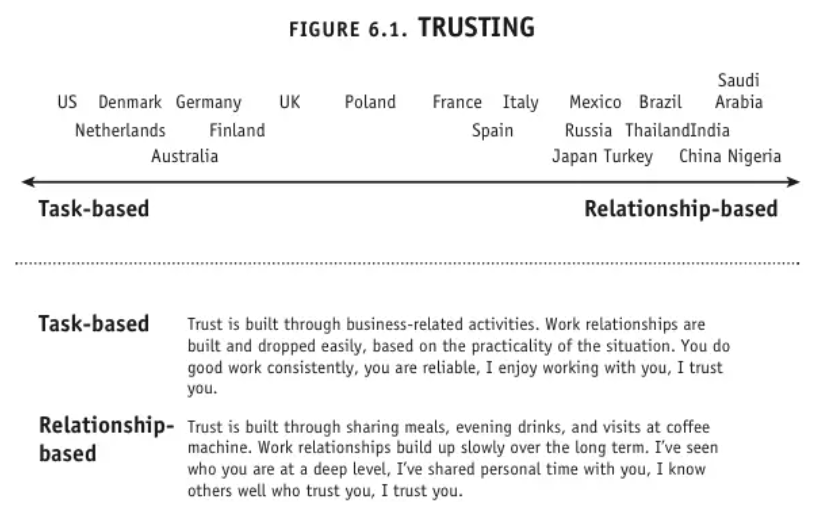
When we started to merge with a new team, I feel the first thing we need to do is to build trust between the team members. When reading Erin Meyer’s book ‘Culture Map’, I realized the way people establish trust is very different in different cultures. Erin roughly described two types: relationship-based and task-based.
- Relationship-based trust is built through common social activities such as having meals together. Whether they like to work with you or not, is very important.
- Task-based relationships are built through business activities. Once a task is completed or business results are seen, trust is gained.
How much time on casual chat?
Let me start with a question: In a business meeting with a new partner, how much time would you spend on casual chat?
As someone who grew up in China, I find it awkward to jump straight into work-related topics when meeting a new partner in the first meeting. Subconsciously, I feel that without establishing a good level of trust, how can we do a good job together?
Recently, I designed a workshop for my new colleagues and invited a US colleague to facilitate with me together. We split into two groups and decided that each group would start with an icebreaker game to get to know each other before the actual topic. In my group, there were many new Russian colleagues whom I needed to build a relationship with. We got very excited and carried on chatting for half an hour without realizing I hadn’t even touched upon the main topic that we needed to discuss, while my American partner did an excellent job of completing the task.
Initially, I thought that I just had bad time management skills, but I realized that the deeper reason was that, my subconscious mind was telling me that getting to know others is essential for building a good relationship and working well together in the future. So, unconsciously I focused on building relationships rather than getting to a specific task. Erin’s scale made me become even more aware of this. My task-oriented American colleague can stop the icebreaking activities appropriately and focus on completing the task as a way of building relationships!
Later, I organized a roundtable discussion on trusting culture with participants with backgrounds living in US, France, Russia, China, Pakistan, and Germany. I asked everyone to compare themselves to the scale above and see if their culture matched the scale. My American colleague protested, saying, “Although the US is at the far left of this scale, I believe I am very relationship-oriented. Before meeting with clients, I always spend five minutes talking about the weather and the weekend, and I also think about their PR needs and how to help them.”
I smiled and said, in China, spending five minutes chatting does not count as building a relationship. To truly establish a relationship, you need to at least have a meal together or spent half an hour chatting. In Singapore, my colleagues had lunch together, and they spent one or two hours chatting and catching up almost everyday. The relationship between colleagues is not just professional but also as a friend. In the US, however, lunch is usually brief, with people quickly returning to their workstations. My Russian colleagues nodded in agreement, saying that Russian and Chinese cultures share the same emphasis on having meals/drinks together to build relationships.
What do you do to a visiting colleague?
In the United States and Germany, people with families usually go home to spend time with families after work, and they tend to separate work and life more clearly. Even if other colleagues come from far away, it can be normal for people to go home after work. However, this can make colleagues from relationship-oriented culture feel very cold and puzzled that they might be not respected or trusted.
Chinese people emphasize a lot on building personal relationships, and if a colleague comes from afar, they will definitely spend time together, such as having dinner together or acting as a tour guide. This is also a matter of etiquette, otherwise it would be considered impolite. (Things are slowly changing in big cities though.) If the visitor asks for city tour recommendations, sometimes we subconsciously think that it may be an invitation for us to go together, and it would be awkward to not accompany the guests. After a meal, Chinese people feel that they have established a good relationship with that person, and may assume that in the future, if they need help, they might have priority (over strangers) because of the relationship they have built. However, in the American companies where I worked in, we were often required to participate in compliance training, that if we have personal relationships with partners, we usually have to avoid them to prevent conflict of interest.
India is also a country that attaches great importance to building relationships. My Indian colleagues told me that if they casually mention that they are getting married, it means they are inviting you to attend the wedding. Similarly in China, if you are hinted for an invitation but do not attend, it may even be considered that your relationship with the person is not good. However, this is not necessarily the case in the United States. Even if you do not attend a colleague’s wedding, it does not affect your normal business interactions. In the States, personal trust and business trust is separated, while in China, they are sometimes mixed together. Colleagues who work together may become friends, and not participating in important events of others may make people feel that you are not sincere.
Ways to build business relationship
After coming to the United States, I found that I received a lot of marketing mails every week. I usually throw them away directly. But I wondered why so many Americans are keen on sending out flyers to strangers? Later, I reflected that compared to Asia, which is more relationship-oriented, Americans have a much higher acceptance rate for unfamiliar commercial emails and physical mails. (Of course, the United States is sparsely populated, and there are fewer opportunities to see non-internet advertisements such as in shopping malls.) However, for people from a relationship-oriented society, it is more difficult to trust unfamiliar emails and advertisements, as you don’t trust it until people you know recommend it; when I first came to the United States, I needed to find a tax accountant. Although there were many resources online, I always felt unsure whether I could trust them. Once a friend recommended one, I immediately contacted them.
In most Asian countries, it is difficult to grow a business without a wide network of personal relationships. Many hiring companies might check your family backgrounds and relationships. Some Korean colleagues told me that, companies in Korea, may even ask about your parents’ jobs to understand your background and decide whether you have any potential useful resources. This is why if a company loses a good sales person, it may lose a lot of clients too. As they became clients not necessarily because of your products, but because of the their relationship with the salesperson.
When you manage the relationship with clients, say, if the client opens a new store, you need to send flowers; during holidays, small gifts are given to clients; mooncakes are given during the Mid-Autumn Festival, and rice dumplings are given during the Dragon Boat Festival. These are all etiquette for maintaining relationships. In Singapore, we have also received gifts from Chinese suppliers who have sent them over across the ocean. Gift-giving is an art, and receiving gifts is also an art.
In China, Japan, and Korea, drinking with clients is a very effective way to establish relationships. You can get a lot of valuable information after drinking good wine. After getting drunk together, everyone shows their most vulnerable side, which shows you’re willing to trust others. If someone is reserved when drinking, sometimes others might feel you’re not trusting enough. My Russian colleagues have also told me that they have a heavy drinking culture too.
In Japan, people usually are very cautious and careful at work and do not express their opinions easily, and will not openly express any dissatisfaction. People value harmony. But after drinking, everyone can relax and reveal their true thoughts. Of course, the next day at work, everyone still behaves the same, as if nothing had happened.
There is an interesting story. I have an American colleague who has always found it difficult to build relationships with the Japanese team and didn’t know what to do. So he went to Japan to establish a relationship with them. After having a good meal and drinks, they all went to KTV together. As they were all men, after drinking they felt so high that they took off their shirts, and sang while hugging each other, half naked. It was so intimate. This American was very happy and felt that he had finally established trust. But the next day he found out that at work, everyone’s facial expressions were still the same, as strict as before, as if nothing had happened, made him extremely puzzled and thought nothing changed.
When I first started to take care of the Japanese market, I was particularly puzzled because I felt that my Japanese colleagues didn’t tell us anything, projects had no progress. The effort we put into our work led to no result, and of course, a significant part of the reason was that I didn’t understand their communication culture, as described in this article. However, I think the deeper reason was that I did not spend time to build trust with my colleagues. That period was exactly when covid-19 started, so I couldn’t go to Japan for business and meet everyone to establish relationships. Another colleague told me that, if you manage the Japanese market but don’t travel to Japan, it is impossible to develop the Japanese market. Now it seems a lot more clear to me.
Pros and Cons of Different Cultures
In a relationship-oriented culture, the close relationship with colleagues could be a burden sometimes. As everyone has limited energy, especially families with children, may not have the energy to participate in more social activities. Additionally, because relationships can sometimes have a greater impact than one’s capabilities, unfairness may happen. It can make individuals feel discouraged and hopeless, especially those who are not born in families with any personal connections. Moreover, this type of society is more prone to corruption and fraud.
On the other hand, in a task-oriented culture, individuals are encouraged to continuously learn and improve their skills because they know that having excellent abilities is the key to success. This type of culture provides opportunities for personal growth and advancement.
Why is the difference?
For instance, suppose you are an American who wants to do business in India. You would like to send your products to an Indian retailer first and wait for them to sell and then pay you back. But how can you ensure that the retailer will pay you after selling the product?
If this deal happened in the US, you would sign a contract before you ship your goods, and even if the retailer breached the contract, you could recover the money through a solid legal system. However, in many developing countries where legal systems are not robust, it is not the case. Even if you sign a contract, it may be challenging to recover the money legally. In such a situation, if you have a personal relationship with the retailer, that relationship is your contract. After all, if you know the retailer very well, know their family, or have common friends, breaking the trust would damage their reputation not just professionally, but also personally.
What strategies can you use?
- It’s clear that if you come from a relationship-oriented society and work with task-oriented clients, don’t be influenced by their direct approach to work, and don’t feel disrespectful when they go home right after work without socialization. This can be very normal in their culture.
- And if you come from a relatively task-oriented society, please remember to spend more time eating with your colleagues/clients, and get to know each other’s lives before diving into work. It is even ok to have a meeting to just say hi or talk about life. You will find that when you get to know him/her better, your next collaboration will be much smoother.
Of course, everyone is different, coming from one country does not mean that a person will always follow a certain way. Our style can be influenced greatly by our environment, universities and our first jobs too. There are also significant differences between men and women when building trust. Men tend to prioritize tasks, while women tend to focus more on building relationships. Understanding these different backgrounds and perspectives, help us navigate through myths and break barriers across culture.
If you also like this article, please help me with a quick survey.

 A Growing Me
Leave a reply to How to convince others in different cultures? – A Growing Me Cancel reply