
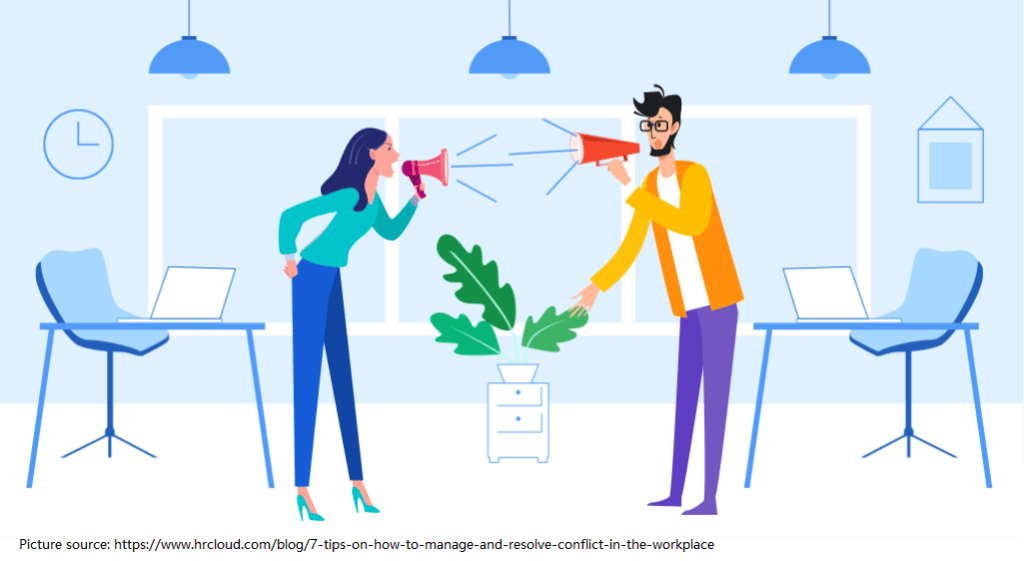
Conflicts can occur between any two individuals, whether it’s between parents and children, spouses, friends, or colleagues; conflicts are unavoidable as we’re all different. You can choose different ways of handling conflicts:
- Avoid the conflict, but continue to feel dissatisfied while maintain a distance in future interactions;
- Have a direct argument and then refuse to cooperate with the other party;
- Share all the dissatisfaction with the other person’s boss/parents/friends, seeking their help in resolving the conflict.
- Engage in sincere discussions together, explore ways to achieve win-win solutions or solutions without losers;
Because conflicts are inevitable, learning how to handle them is, in my opinion, one of life’s required courses. Someone who can handle conflicts well benefits in various aspects of life:
- They can build a strong network and have greater influence in the workplace.
- They can maintain harmonious relationships with their spouse and support each other.
- They can treat their children with respect and sincerity, nurturing children who can rationalize problem-solving and manage their emotions.
- They can make genuine friendships, maintaining a balance between closeness and warmth.
Unfortunately, sometimes school education lacks a course that teaches us how to face our differences with others, respect these differences, and deal with negative feedback and conflicts.
Cultural Differences In Conflicts
While reading Erin Meyer’s “The Culture Map,” I learned about significant differences in how conflicts are handled across different cultures. Understanding these differences has brought me great excitement because without this knowledge, it is easy to fall into a self-doubt mode.
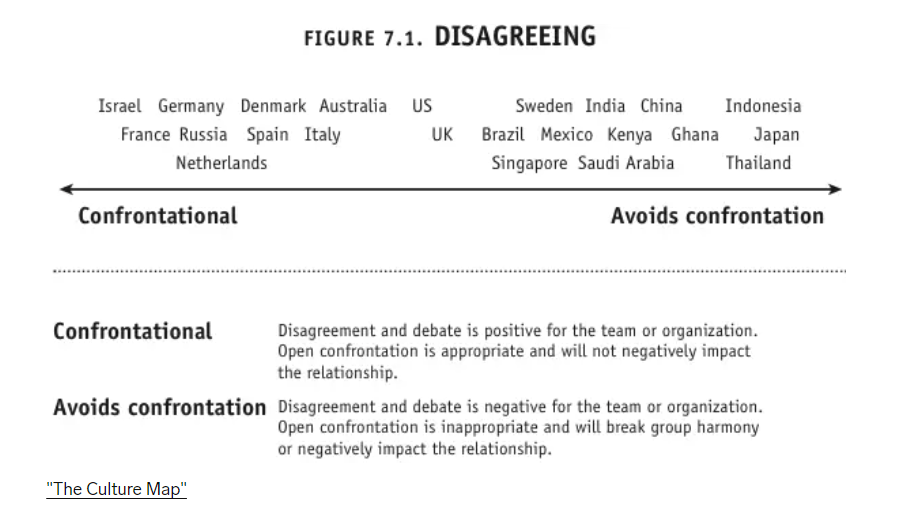
Most Asian countries fall on the side of “Avoids confrontation”. Intense debates are seen as disharmonious and detrimental to both families and teams. If you express dissatisfaction with someone’s actions, they are likely to associate it with personal dissatisfaction. Arguments over topics might be seen as disapproving individuals.
On the other hand, most European countries like Germany, France, Russia, and others fall on the side of “Confrontational”. They believe that arguments and debates have positive effects, so they do not shy away from conflicts. Conflicts also do not necessarily affect relationships. They are more likely to separate opinions about facts/events with personal. I also heard that children in German schools are taught to separate opinions about people and events.
Meanwhile, countries like the United States, the United Kingdom, and others fall in the middle of this scale. Compared to Asians, they confront conflicts more directly, but compared to many Europeans, they still tend to avoid conflicts.
Of course, this chart represents a general trend, and every individual is unique. Being in a particular country does not necessarily mean that you will always approach conflicts in that way, especially considering the influence of our individual upbringing, work environment, and educational background. This chart only summarizes the situation for the majority of people.
I have also deeply experienced these differences in the workplace.
Conflict with Asian colleagues
In Asia, there is great importance placed on maintaining harmonious relationships. Engaging in debates with others is often seen as impolite or inappropriate. If a child contradicts an adult, it is frequently considered disrespectful behavior.
Recently, I had disagreements with a team member from Taiwan on certain projects, and we engaged in intense debates privately. Personally, I didn’t feel that these heated discussions would affect our relationship because I have been exposed to people from different cultures through work and have learned to confront conflicts like many French people do. I believe that intense discussions allow me to see different perspectives.
However, afterwards, this team member started apologizing to me, feeling that her tone was inappropriate. I totally didn’t feel it. It made me realize that, in her subconscious, these debates about matters could potentially be perceived as personal criticisms. It may have made her feel uncomfortable, attacked, and disrespected, and potentially affecting our future relationship.
I immediately clarified the situation and shared with her the differences outlined on the cultural map. I explained my perspective on open debates, emphasizing that discussing matters doesn’t imply any biases or prejudices against her. I wholeheartedly respect our differences and equally respect the decisions she makes. In the end, while addressing this issue, she incorporated some of my feedback while maintaining her own approach, and we quickly achieved our desired outcome.
Later, the team member shared with me that she was also influenced by Japanese culture due to her grandfather’s background. It became even more clear to me, because Japanese culture strongly emphasizes avoiding direct confrontations, especially when dealing with elders or superiors. Understanding this situation better, I now have a clearer idea of how we can handle conflicts in the future.
Conflicts In Japan
A few years ago, when I was managing a Japanese team, I encountered significant challenges. One of the reasons, of course, was the inability to travel to Japan due to the COVID-19 pandemic, which made it difficult to establish a trusting relationship with everyone. This had a significant impact, as I explained in this article. But the most important reason was my lack of understanding of Japanese culture, their perspective on conflict, and knowing how to manage constructive feedback effectively.
At that time, I found that our projects were not progressing no matter what I did, and I was puzzled. In meetings, I often hoped to receive feedback from everyone, but people were extremely reserved in their communication. In every meeting, even those scheduled for an hour, everyone would provide a very brief summary of the week’s highlights in just one sentence, and the meeting would be concluded within 20 minutes. I was truly taken aback by this approach and felt a bit lost. If every meeting was like this, how could I gather the necessary information to carry out my work?
Later, I sought out team members who were familiar with Japanese culture to discuss the situation and explore ways to improve. One of them told me that in Japan, meetings are not meant for discussion. Usually, decisions have already been made prior to the meeting, and the meeting itself is merely a formal announcement process. If you need to discuss or obtain details, you have to privately speak with individual members.
This insight was an eye-opener for me and truly ah-ha moment. Finally, I understood why every Japanese meeting was structured in this way. In Japanese culture, people strive to avoid conflicts. Even if you ask for everyone’s opinions in a meeting, expressing differing views would be seen as contradictory and highly impolite. That’s why everyone keeps their contributions brief and avoids discussions during meetings. This is especially true when you hold a higher position, as it becomes even more unlikely to hear dissenting opinions in a public setting.
At that time, having had more interactions with people from Western countries, I was accustomed to scheduling meetings specifically for discussions and decision-making. I wasn’t accustomed to the fact that in Japan, meetings were primarily meant for announcing decisions. After understanding these cultural differences, I felt relieved and gained a clearer understanding of how to interact with them in the future. If I held a higher position, I could avoid attending meetings and let them discuss and provide feedback afterward. Alternatively, before the main meeting, I could hold separate meetings with individuals to understand their perspectives, so during the main meeting, there would be less need for extensive discussions since we would already be aware of everyone’s viewpoints and reach a consensus.
Working With French Bosses
In most European countries, such as Germany, France, Russia, and others, openly expressing dissatisfaction or engaging in debates is a common and acceptable behavior. When discussing projects with my French boss, he often challenges me or presents various possible examples for me to counter-argue. These intense discussions provided me with an opportunity to see very different perspectives. Later, when I engaged in debates with him, I also expressed my opinions without reservation. It may seem impolite to the boss, but it has no effect on our relationship. We are like friends.
The French people love expressing their dissatisfaction, as can be seen from the frequent strikes and demonstrations. Almost every time I visit France, I find myself either caught in a strike that affects public transportation or receiving warnings about upcoming strikes and their locations. These situations are something I rarely encountered during my decades of living in China and Singapore. In Asia, strikes or demonstrations are strictly controlled, and openly expressing dissatisfaction through these forms of public protest can easily make Asians feel uncomfortable and fearful.
Challenges of International Meetings
During an international meeting, there was a time when I expressed a different opinion from my American colleagues and stood firm in my own ideas. Towards the end of that year, during the yearly peer review, I invited a Japanese colleague and earnestly asked for constructive feedback. He left me a message, delicately expressing that during a certain meeting, he felt that I might have left a cold impression on others. It took me a long time to reflect and realize that it was because during that project, when there were disagreements with my American colleagues, particularly when they held higher positions than mine, we engaged in debates during meetings. However, my relationship with the American colleague with whom I had arguments in meetings at the time is now very good. I imagined, if I was engaged in a debate with my Japanese colleague back then, they would probably have been angry for a long time. Of course, I believe that my Japanese colleagues would have exercised restraint during the meeting, refraining from expressing their opinions and engaging in debates with me. I think this is one of the reasons why my project was not progressing at that time.
In Asia, the order of seniority is highly important. In “The Rules for Young Disciples,” it is stated, “Address elders respectfully, avoid calling them by their names. Behave humbly in the presence of elders.”
- Challenging someone older than oneself can make others feel losing face.
- Challenging someone in a higher position can make others feel losing face.
- Children challenging their parents are considered to be unreasonable and very disrespectful.
In China, Japan, and Korea, these social hierarchies are highly respected. If there is any dissatisfaction, it will not be directly expressed but rather conveyed through subtle hints and allusions.
Gender Differences
There are significant differences between men and women when it comes to dealing with conflicts too. In most cases, men tend to approach conflicts in a more rational manner, separating their opinions about the person from the issue at hand. On the other hand, women often exhibit more emotional responses when dealing with negative feedback, perceiving others’ criticism of a matter as a personal attack. Many times, in marital disputes, a minor issue can escalate to the point where it becomes about “you don’t love me” or “you don’t care about me,” bringing up past issues that have long been resolved and deviating from addressing the specific matter at hand. In such situations, it is crucial to first manage emotions effectively. You can refer to this article for strategies on how to handle arguments: “What to Do When You’re Having an Argument.”
What Strategies to Manage Conflicts
When you want to offer feedback or initiate some debate, you can use the following methods:
- Start by acknowledging the positive aspects of what the other person has done and mention their strengths before gently addressing areas for improvement. For example, you can say, “This project has progressed quickly under your proactive efforts. It would be even more perfect if we could make some minor improvements in XX area.” Soften your tone if you come from a confrontational culture.
- Before engaging in a debate, explain, “Let’s carefully discuss both sides of the argument.” Clarify the reasons for having a debate, making it more convincing that this is a healthy discussion.
- When you disagree with someone’s viewpoint, instead of saying, “I disagree with you,” it is better to say, “I disagree with a particular point.” Separate the person from the issue when expressing your opinion.
- When providing feedback, point out specific areas that can be improved, allowing the person to know how and where to make changes. If you simply say, “You did poorly,” without indicating which aspects can be improved and how to improve them, it becomes a mere critique rather than constructive advice. Such comments can easily be interpreted as personal attacks. The reason someone may not perform well is often due to a lack of awareness of better approaches, so providing guidance can facilitate smoother improvements.
- Whenever possible, give the advice directly to the person involved. If you relay the feedback through someone else (e.g., a boss, family member, etc.), it may make the person feel more embarrassed or even angry, as if you are deliberately tattling on them. Providing advice directly demonstrates your sincerity.
- Offer feedback promptly rather than waiting for a long time and accumulating negative feedback. By doing so, it becomes difficult to address each issue individually, and the conversation may devolve into a negative judgment of the person rather than a constructive discussion of the matter at hand.
When you receive some negative feedback, you can try these:
- Find the positive meaning behind conflicts. These conflicts represent different perspectives. It is through these conflicts that you can gain different perspectives and better understand yourself. You need to realize that nobody is perfect. When others provide you with suggestions, it signifies that they may offer viewpoints you haven’t considered, and these viewpoints can help you grow and become a better person. Take the time to listen to others’ different perspectives.
- Differentiate between feedback that targets the person and feedback that targets the issue. If it is a personal attack, you don’t need to dwell on it or let it bother you. If it is feedback about the matter at hand, you can assess whether what others say aligns with your perception of reality. If it is genuine feedback, you can use it to improve yourself. However, if you feel that the feedback is incorrect, you can sincerely present your perspective to others. Perhaps they are the ones who are mistaken? By sharing your viewpoint, you provide them an opportunity to see things from a different perspective.
- Manage your emotions. When we receive negative feedback, our initial reaction is often resistance or even anger. Allow yourself to feel angry, allow yourself to experience emotions, and acknowledge any feelings of rejection or hurt. Hug yourself, write down your emotions and feelings, or just go out to have a cup of tea or go for a run. It’s impossible to think clearly when you are in an emotional stage. This article provides some techniques for managing emotions.
Hope you like the article and here’s a quick survey
Related Articles:
Cultural Differences In Communication
How to convince others in different culture
What to do during a heated argument?
How to build trust in different cultures?

 A Growing Me
Leave a comment