
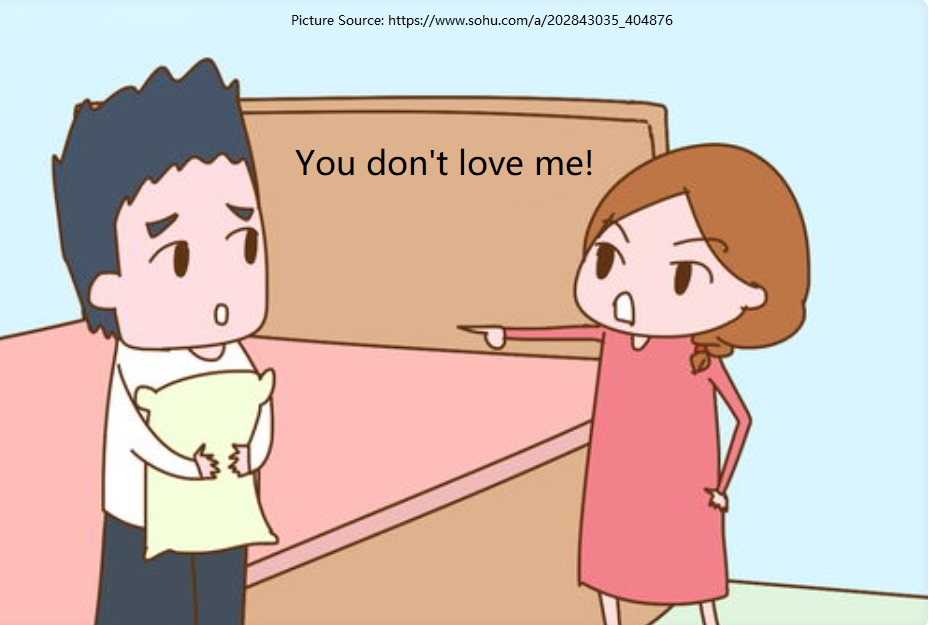
What leads to “you don’t love me”?
I often hear my female friends complaining about their boyfriends or husbands doing something that makes them extremely angry. Interestingly, many times the argument starts from a trivial matter, but somehow it escalates to the level of “you don’t love me.”
I have experienced this situation many times as well. The pattern is mostly like this:
Me: I had a disagreement with my husband, and it made me very angry.
He: I tried to reason and solve the problem.
Me: He disregarded my feelings. I’m angry, so I decide to ignore you.
He: Seeing her so upset, maybe I should let her cool down. I’ll do my own thing, play a game, or watch a movie.
Me: Oh my, he’s playing a game! Can’t he see how angry I am? Why is he enjoying his life and playing games while I’m so angry? This situation makes me even angrier, and the anger keeps escalating. (At this point, I’m not really concerned about who’s right or wrong.)
He: The game is over, and she still looks angry. Let me go and comfort her.
Me: Hmph, don’t mind me! Just go on playing your game! (Though I want him to comfort me.)
He: Alright then, I’ll continue playing. Quietly walks away. (Sometimes, it’s better not to invite trouble. )
Me: He hasn’t come to comfort me after all this time. It’s so frustrating! I’m so angry that I can’t sleep. I wake up the next day still angry, and the anger continues.
He: Maybe she’s calmed down after sleeping all night. Just treat it as if nothing happened. After all, it’s a small matter.
Me: This “treating it as if nothing happened” attitude makes me even more infuriated. Don’t you care about me anymore? Don’t you love me anymore? Can’t you see how angry I am?
Like this, a small disagreement turns into the serious fact of “he doesn’t love me.” And these events, all stem from the initial stage where both parties failed to focus on managing emotions and instead concentrated solely on solving the problem. With the lack of resolution over time and several instances of cold war, conflicts accumulate and relationships become more and more strained.
Managing Emotions Should Be Prioritized!
Why is managing emotions more important than solving the problem itself? Because sometimes, the way we handle problem-solving is even more important than the solution itself.
Maya Angelou, an American writer who grew up in a ghetto, once said something that left a profound impression on me:
“I’ve learned that people will forget what you said, people will forget what you did, but people will never forget how you made them feel.”
-Maya Angelou
When conflicts arise and both parties disagree with each other’s perspectives, our instinctive response is to fight back. Conflict often makes the person feel rejected, hurt, lack of love, and a lack of security. Therefore, it is a very normal reaction for arguments to escalate to the point of “not being loved.”
Humans naturally remembers the negative feelings a lot more than happy feelings, as that kept us survive. Remembering danger helps us avoid future harm.
Women tend to be more emotional than men, which is likely related to human evolution. In ancient times, men were responsible for hunting. And when faced with danger, if they continued to rely on their emotional brain rather than using their powerful rational brain to analyze the best solutions, they would likely have been eliminated by nature. On the other hand, women often had to take charge of social activities and childcare, which required strong emotional support. Over thousands of years of natural selection, the emotional differences between most men and women gradually became apparent. Men often quickly transition from the emotional brain stage to rational analysis stage. However, gentlemen, you thought you were reasoning, your lady might not be able to listen at all! Their rational brain hasn’t been activated, when women feel rejected, hurt, and unloved. Only by helping women process their emotions first can they possibly listen to your reasoning and work together to solve the problem.
People trapped in their emotions have very limited brain bandwidth, just like a road under maintenance that blocks the way. In such situations, trying to reason forcefully, especially when labeling someone negatively, is more likely to provoke resistance and anger from the other person. It may even lead to a backlash where they deliberately do things to make you feel uncomfortable. As the Chinese saying in “Rules for Young Disciples. goes, “If advice does not enter, wait until the person is in a good mood to advise again.” Wait until they are in a happier state to have that conversation.
Of course, everyone is different, and there are men who are more sensitive and women who are more rational. These differences are closely related to our upbringing and environment. During the process of growing up, if we have highly emotional elders, children can be subtly influenced in the same way. I remember myself being very emotional in the past, it was deeply influenced by my mother and grandmother.
Each of us has mirror neurons, which are imitation neurons that enable us to learn. When we see what people around us are doing, we are also prone to imitate their behavior.
Research has shown that children raised by single mothers are more sensitive to perceiving others’ emotions compared to those raised by fathers. This may be because men are often assigned the role of not displaying their emotions openly in society, as expressing emotions can be seen as vulnerability. Consequently, children raised by fathers naturally have fewer opportunities to perceive emotions.
Understanding why we would have own emotions and staying aware allows us to gradually gain control over them.
How to deal with emotions?
If you are the more rational person and want to take measures after an argument, you can:
- Temporarily control your desire to make logical arguments. Pause for a moment. (Especially avoid labeling others.) When someone is caught up in an emotion, it is not the right time for reasoning. Wait until they are in a better mood before trying again.
- Try to understand the deeper emotions of the other person and articulate their feelings. For example, say, “I can see that you’re very angry. Are you feeling afraid/ sad/confused, etc.)?” Everyone wants to be seen and understood. When a person is angry, it’s because certain needs are not being met. They may feel disrespected, rejected, or lacking a sense of security. These unmet needs often manifest as anger. If you only see their superficial anger without considering the underlying unsatisfied needs, you might come to the conclusion that the other person is unreasonable. However, if you let go of your preconceptions and assumptions, and genuinely try to listen to their feelings, they will sense your unbiased approach and see that you genuinely care about their well-being and the well-being of both parties. This is not an easy thing to do, but you can learn it gradually.
- Provide emotional support, such as saying, “I feel upset when I see you sad” or “I’m really worried about you.” This can greatly enhance their sense of security and their willingness to open up and solve problems together.
- Acknowledge that both parties are different but it shouldn’t affect the love between you. Say, “We have different opinions, but I still love you.” It’s normal for any two individuals to have different opinions and different ways of handling things. Debates are healthy to resolving future problems. Recognise them just like in this article.
- Hug him/her, a warm hug. If you can’t hug the person, simply telling them, “I’m here for you” is enough, even if you don’t do anything else.
- Do something they like. Also, think about what activities would make them happy in general. Sometimes, the solution to a problem doesn’t lie directly in that problem itself. Doing something else that brings them joy might naturally resolve the problem.
Often, the party that takes the initiative to reconcile after an argument is the one with more stable emotions, as well as being more mature. You might surprisingly find that once you have managed your emotions, the other person might have already come up with a solution on their own.
If you’re not comfortable to do steps 2-5, at least do step 1 or step 6—don’t add fuel to the fire and let your emotions cool down.
And vice versa, if you find yourself caught up in emotions, it is crucial to maintain awareness because it’s the first step to overcoming them.
- Feel the emotions: Notice what kind of feelings you are experiencing—anger, hurt, or sadness?
- Understand the reasons: What are the underlying causes of these emotions? Is it due to a childhood trigger? Does someone’s behavior make you feel insecure?
- Acknowledge the emotion: Allow yourself to feel angry, hurt, or sad.
- Write down the above points: You may find that as you write down these points, those feelings gradually disappear. When you put them down in writing, your rational brain begins to take the lead. Once your emotions no longer occupy your brain bandwidth, you can start to address the issues. At this point, you can continue by writing down several potential solutions and share them with the other person.
- Identify ways to handle this emotion in the future: Determine how you would like to deal with this emotion when it arises again. For example, going for a run, going to the gym, skiing, playing basketball, or watching a movie.
In a close relationship, both parties often reveal their most vulnerable parts, without reservation. By first managing emotions and then handling conflicts, solutions come a lot more easily.
Every individual is different, and conflicts exist in any relationship. However, how both parties handle these conflicts determine if the family is surrounded by love or hate.
You can also read this article to manage conflicts more effective. How to manage conflicts effectively?

 A Growing Me
Leave a reply to How to manage conflict effectively? – A Growing Me Cancel reply